Impacts of AirBnB regulation in New York
New York has long been a money spinner for AirBnB. In January 2023 there were 38,500 listings. As…



New York has long been a money spinner for AirBnB. In January 2023 there were 38,500 listings. As…
In 2010 the Commonwealth Association of Planners held its first Student Essay competition. The winners were Jeremiah Atho…
Ken Loach’s film, Kes, was released in 1969. What does it tell us about life in a coalfield…



Cliff is a freelance consultant, researcher, author and trainer. He was the Chair of the Cockburn Association 2016 – 2023.
He is Professor Emeritus of Planning and Spatial Development at Heriot-Watt University in Edinburgh.
He is a Past President of the Royal Town Planning Institute, and of the Commonwealth Association of Planners.
He is a past Chair of Built Environment Forum Scotland.
He was awarded the O.B.E. in the 2016 Birthday Honours.
Link to download for free
Link to buy
This blog was first posted on the Planning Resource website on 7 February 2012. Richard Florida’s writings on the creative class have underpinned much of the urban regeneration work in Europe, Australia and North America over the past decade. The creative sector is also getting increasing attention in India, Brazil and China. A new publication from…
This was first posted in 2016. New Zealand’s right-wing minority government is amending the legislation that defines the planning system, to address what it calls problems with “cumbersome planning processes”. The Minister, Dr Nick Smith called it “a moderate reform Bill that will reduce the cost and delays for homeowners and businesses”. He introduced the…
Progress on a European Platform for Applied Territorial Science, Third ESPON 2013 Scientific Report, December 2014, (2015) https://www.espon.eu/topics-policy/publications/scientific-reports/third-espon-2013-scientific-report Author of Chapters 5 and 7.
Last week in Cyprus, I was able to get some insights into the development challenges facing this part of Europe. In a snapshot, Mediterranean islands like Cyprus were early cradles of urbanisation and often have a rich archaeological legacy. They were poor agricultural areas until mass tourism began in the 1970s. The boom saw the…
Territorial Dynamics in Europe: European Neighbourhoods, ESPON Territorial Observation No.11, (2014) . Co-author.
This blog was first posted on the Planning Resource website on 21 February 2011. It was great to see the Commonwealth Association of Planners given the President’s Special Award at the RTPI Awards ceremony in London recently. Retiring RTPI President Ann Skippers emphasised the work CAP does in supporting planners across the Commonwealth. She invited the audience to imagine…
It’s been a busy summer. In particular I have been involved in work on “measuring success” for Scotland’s Historic Environment Strategy. As Chair of the Built Environment Forum Scotland I am chairing a “workstream” on this topic, with a brief to report to the Scottish Government and to the historic environment sector by the end…

In a week when my term of office as President of the Royal Town Planning Institute came to a close, I also faced being made redundant. This largely inconsequential article that I wrote in 1997 is redeemed by the photo of me wearing my Eric Cantona T-shirt while meeting a pirate. It also provides some…
This blog was first posted on the Planning Resource website on 11 April 2011. Across the world, administrative boundaries, and particularly international borders, are blocks to economic development, management of energy and conservation of natural resources. Rivers flow across frontiers, where flood prevention measures differ. National energy policies and grids constrain efficiency. Small towns split by a border…
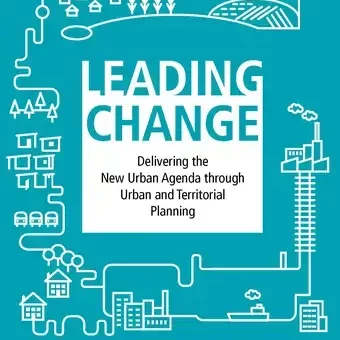
A conference at the University of Birmingham on 22 March, 2018 on “Planning Challenges in the Commonwealth” was the venue for the UK launch of the book “Leading Change” My co-authored book, “Leading Change: Delivering the New Urban Agenda through Urban and Territorial Planning” had its UK launch at the conference “Think Planning – Think…